Businesses are growing, and visits to e-commerce sites explode in the fourth quarter. During these last three months of the year, good remarketing techniques and targeting are essential for visibility.
What to do? Why do we pay more attention in the fourth quarter ? What are the factors to take into account to make the difference?
The fourth quarter corresponds to the months from September to December. During this period, Internet users are doing more product research, and your audience and traffic will increase.
That’s why your targeting needs to be extremely well thought-out, and your digital communication needs to be effective.
With the arrival of the cold and bad weather, and especially the festive season, consumers are spending more time in front of their screens (computers and mobiles).
The seasons motivate us to change our wardrobe or make changes at home. Find family gifts or prepare orders for sales or Black Friday; It’s the perfect time to be visible and present to meet demand.
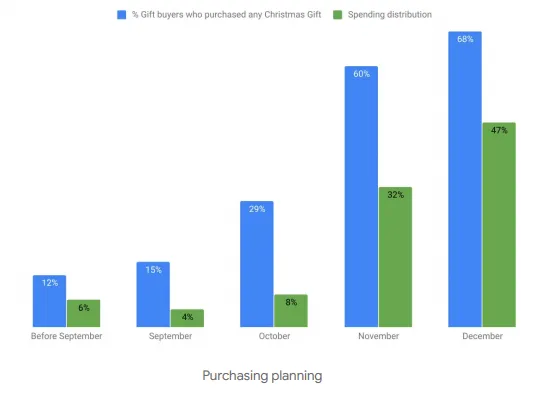
November and December are the most important gift-buying months of the year, and the search for gifts begins as early as the beginning of October.
Mintel 2018
Important dates at the end of the year
From September to December, there are several major events to boost sales: Halloween, New Year’s Eve, Black Friday and Cyber Monday. This is a time when consumer spending is at its peak. It’s essential to create communication campaigns and target your audiences.
If we talk about Black Friday alone, we should remember:
growing French interest in the event
Black Friday didn’t slow Christmas growth in December 2018
Mobile accounted for 69% of the traffic for clothing websites during Black Friday and Cyber Monday
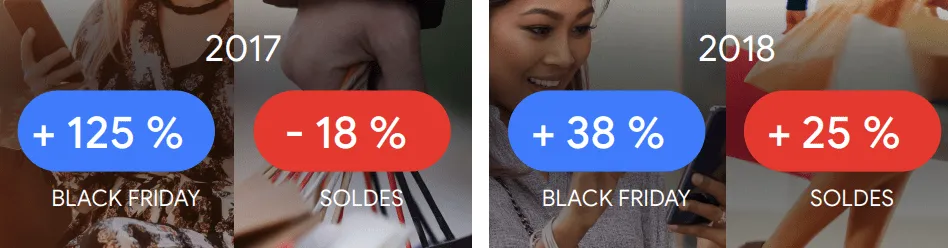
Evolution of Black Friday and sales from 2017 to 2018
To keep up with the competition, one of our tips is also to review your keyword targeting and the themes you want to cover.
Consumers conduct new searches and are more likely to buy your products.
Why not combine your audience parameters with keywords such as “Christmas gift ideas”, “black friday promotions” or “50% cyber monday”.
During these end-of-year months, you need to implement a remarketing strategy. You need to re-engage Internet users who perform a certain number of actions on your site.
Without the act of buying, the prospects who came to your site must not forget your existence. and be visible as soon as your prospect is ready to buy.
Your online store needs to establish itself as the expert in your industry. With Facebook Ads and Google Ads, you can easily target these pre-qualified audiences, who mustn’t forget you.
Be responsive to ensure the customer experience
The biggest orders arrive during Black Friday and the month of December. As demand increases, e-tailers need to be ready. Black Friday isn’t just about sales on the day.
The effect of this event lasts over time: we’re no longer talking about a day, but rather a week of promotion. All these factors need to be taken into account if you are to have enough stock on hand for the boxes 😉
Purchases can also be extremely well thought-out. Some consumers spot before and then buy during promotions. We need to take advantage of this practice with remarketing on Google and Facebook.
They need to see the product, but also feel that it’s an exceptional offer that won’t be repeated. The fear of not taking advantage of the discount motivates them to buy.
During the fourth quarter, e-tailers have great sales opportunities. To be successful, it’s essential to have well-configured remarketing campaigns and target audiences.
What is the average click-through rate (CTR) of a Google Ads ad? When people ask this question, it’s often because they want to evaluate the click-through rate of their own ads.
CTR = Clic through rate => click-through rate
Unfortunately, too many advertisers are content to achieve an average click-through rate and leave it at that.
Here’s an article to help you maximize your click-through rate and triple your performance on the average Google CTR.
What is a good click-through rate (CTR) on Google?
This obviously depends a great deal on your industry, the competition and your objectives. However, you should know that marketers who settle for 2-5% CTR are not up to the job.
We can’t see our competitors’ data, so we don’t know if their CTRs are similar to ours.
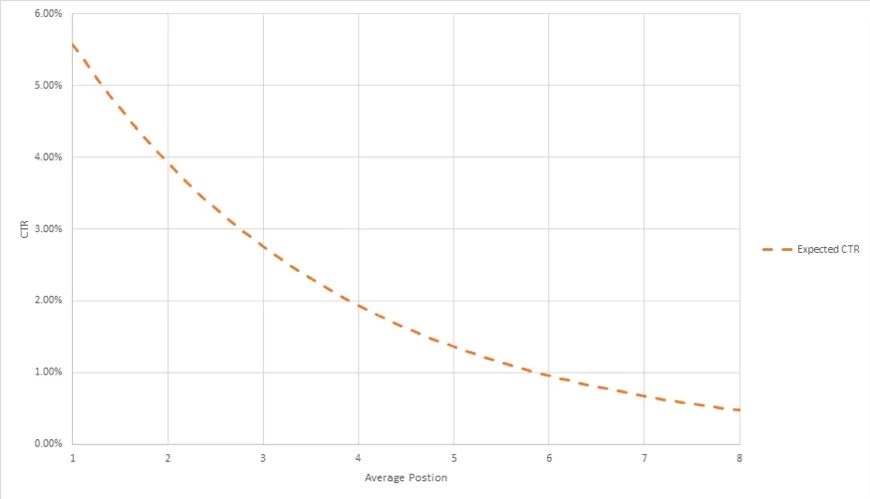
What we do know, however, is that whether or not our CTRs are “good” depends largely on the position of our ad. Ads in higher positions naturally have higher CTRs than those in lower positions.
The chart above reflects average CTRs per ad position on Google, based on an analysis of nearly 100,000 advertiser accounts representing $3 billion in annualized spend. This gives a pretty good idea of the big picture when it comes to the CTRs that real advertisers are actually experiencing.
So the ad in second place has an average click-through rate of 4%. You might think that’s good, but it’s just an average. So if that’s what you’re seeing in your account, you’ve got plenty of room for improvement.
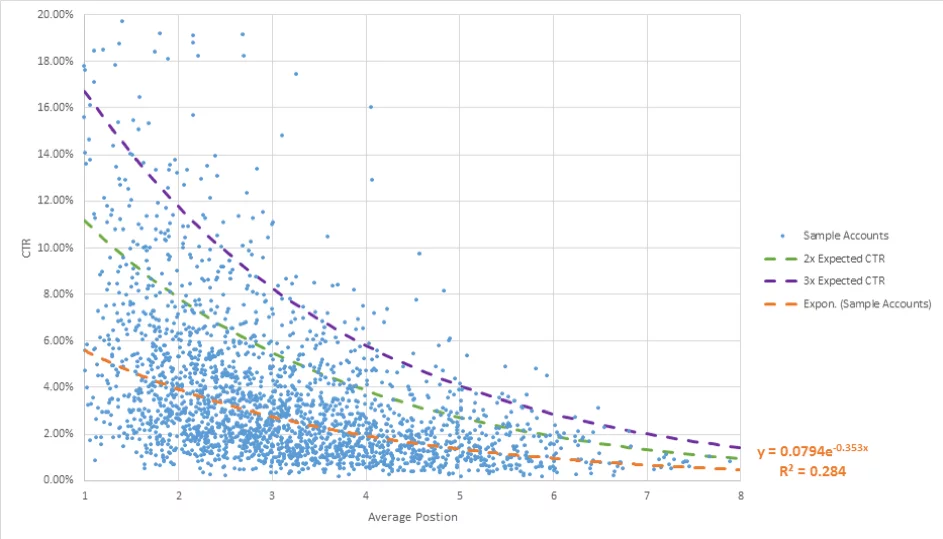
Averages are fine, but there’s still a lot of variability between advertisers, as you can see in the graph below. Remember, these are not keywords – each blue dot indicates an advertiser account.
In this chart, you can see the expected or average CTR curve in orange, while the green and purple curves show what you need to aim for if you want to achieve CTRs two to three times higher than average.
These data show us that there are indeed a few accounts that stand out from the crowd and far outstrip their competitors. What does it take to be one of these exceptional advertisers?
The bottom 50% of advertisers achieve average or lower CTRs. If you want to be among the top 15% in the highly competitive Google Ads landscape, you need to achieve an average CTR on your account that’s twice the average (we call these “awesome” advertisers). If you achieve a CTR three times the average, you become a super-awesome advertiser, which is the case for about 1 in 20 advertisers.
You can quickly check whether your own CTR is above or below the average for your sector.
But why not aim for the stars? If you want to be in the top 1%, you need to achieve an average CTR six times the norm – we call these advertisers “Unicorns”. They’re rare, but I promise you that Google Ads unicorns do exist. They’re not inherently better than you; they just work harder and optimize their campaigns better.
So how do these unicorns do it? First, we need to understand…
The importance of quality scores and how Google Ads works
Understanding how AdWords auctions work is essential if you want to optimize and improve your performance.
Google ads are live auctions. Google must determine the ranking position of each ad, as well as the cost of each click, in real time for each ad in the auction.
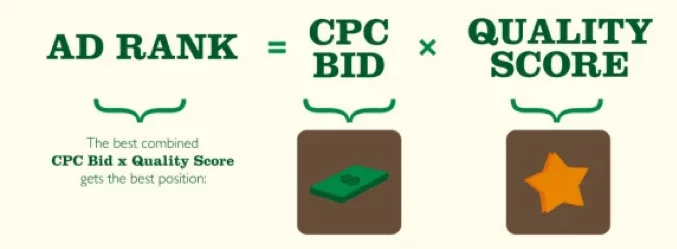
Google uses ad ranking to determine your position in the auction and your CPC. The latter is calculated by multiplying the maximum cost-per-click bid (the maximum you’re willing to pay for a click) by your Quality Score (Google’s assessment of the quality of your ads).
Note: Google has recently updated Ad Rank to include the expected performance of ad extensions, but the basic principle remains the same.
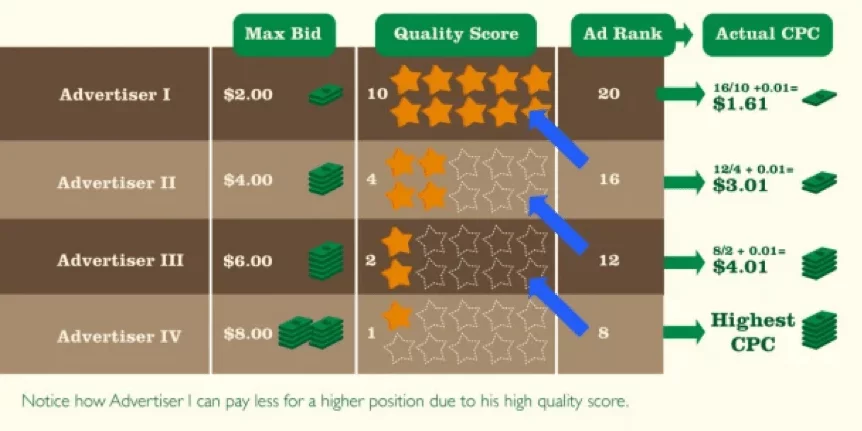
In this example, you can see exactly how Quality Score can affect your performance in this live auction.
The main advertiser, who obtained the first position, had a maximum bid that was $2 lower than that of his competitor, but his Quality Score and therefore his ranking were much higher, enabling him to obtain a better position and a lower CPC :
Google does this because it doesn’t get paid if no one clicks on its ads, and therefore prioritizes the ads most likely to succeed.
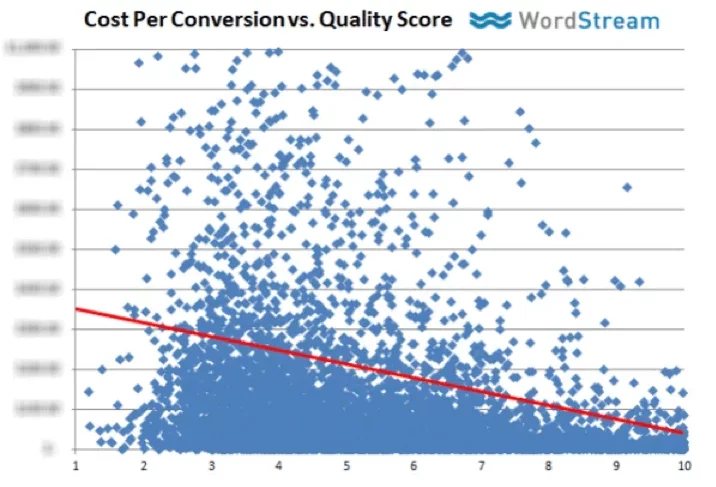
The average Quality Score is around 5.1 out of 10.
If you have an above-average Quality Score, you can get up to 50% off your cost per click. Conversely, if you have a below-average Quality Score, you can pay up to 400% more.
But CPC is only one measure among many. What about the actual cost per conversion? Here, we’ve also seen an inverse relationship, across billions of dollars of ad spend, whereby as your Quality Score increases, your cost per conversion decreases, because your clicks are so much cheaper.
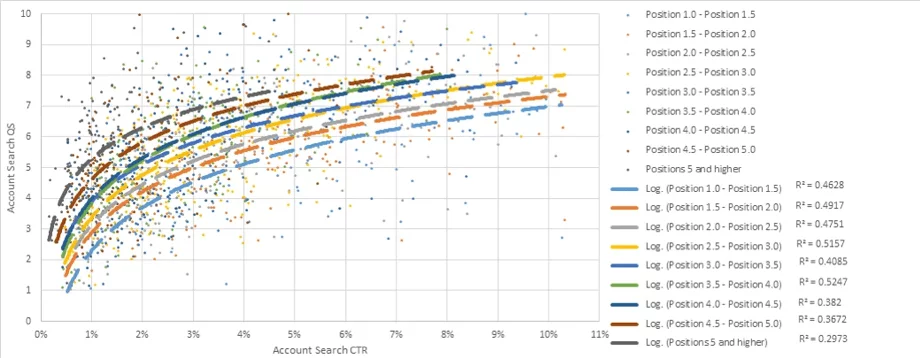
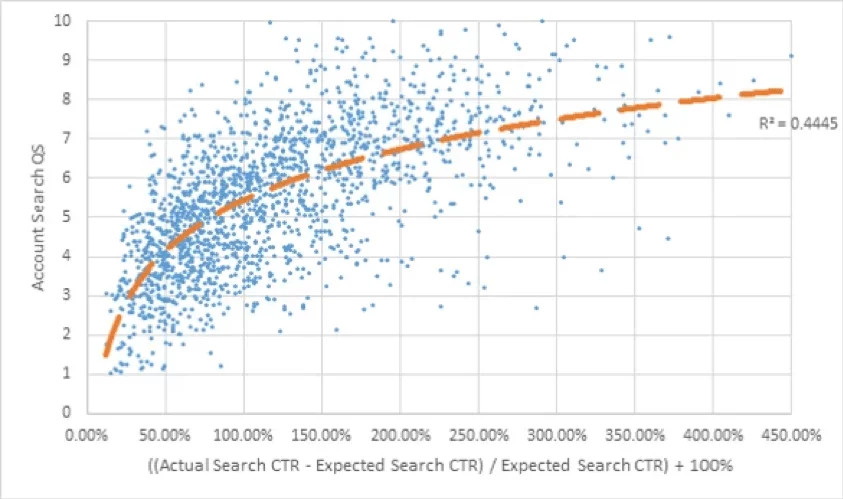
How is Quality Score calculated? In general, the higher your CTR, the higher your Quality Score. However, as you can see from the chart below, there’s a lot of variance, thanks to ad positioning.
As we saw earlier, ads at the top of the page are predisposed to getting more clicks than those further down.
The blue line at the bottom, for example, refers to keywords in positions 1.0 to 1.5. Quality Score is not calculated solely on the basis of your CTR, but on the basis of your over- or under-performance in relation to the expected CTR.
In the following graph, you can clearly see how important your CTRs are in calculating your Quality Score.
It’s all relative.
Your Quality Score, which is the key to getting prominent ad placements and low CPCs and CPAs, isn’t entirely based on your CTR. Rather, your ads and keywords must be above the expected average. This is the key to a high Quality Score.
What about these unicorns? We’ve seen so far that an above-average CTR will help you achieve your goals, but to be better, you need more.
When we see “unicorn” accounts in the AdWords Performance Grader, they share some common characteristics:
– Every keyword in their account has a high Quality Score. – They make effective use of negative keywords to reduce unnecessary expenditure. – Their high impression share shows that Google loves to show their ads. – They have very high, impressive double-digit CTRs that are several times higher than the average. – They target very specific, long-range keyword phrases. – Their account activity is high – they continue to optimize and improve all the time.
If you can focus on ad and keyword combinations that have these above-average CTRs, the rewards are enormous: higher impression shares, higher ad positions, lower costs per click and lower conversions.
The unicorn hunt
By now you know what Google Ads unicorns look like, and you should have a good idea of why they’re so desirable. Let’s take a look at each of these features so you can replicate this success on your own account.
Unicorn keyword strategy
The top 1% of all Google Ads accounts tend to focus on keywords with strong commercial intent. This is not surprising, as people tend to click more when they are already motivated and intend to buy. For example, “best Internet marketing software” or “stainless steel dishwasher” are keyword phrases that demonstrate buying intent.
Branded keywords are another fantastic opportunity for advertisers, but we’re not just talking about your own brand. Target partner brands, competitor brands or other brands that your target market might be looking for when they’re in buying mode.
A third type of keyword that performs well are local keywords, where the searcher’s intention is to find your business – or your competitor’s (for example, “San Diego personal trainer”). These words tend to get high click-through rates, as local searchers often have strong commercial intent.
Avoid informative keywords wherever possible. These are often formulated as questions, such as “What is a dishwasher?” or “Where is Paris?”. These searchers tend to look for Wikipedia-type information and have no intention of buying, which can result in a lower CTR or unnecessary spend.
Warning about dynamic keyword insertion If you want to achieve unicorn status, don’t overuse dynamic keyword insertion, or DKI. This is a strategy that consists of using a certain syntax in your ads to enable Google to automatically substitute the keyword that triggered the ad in the ad’s text or title.
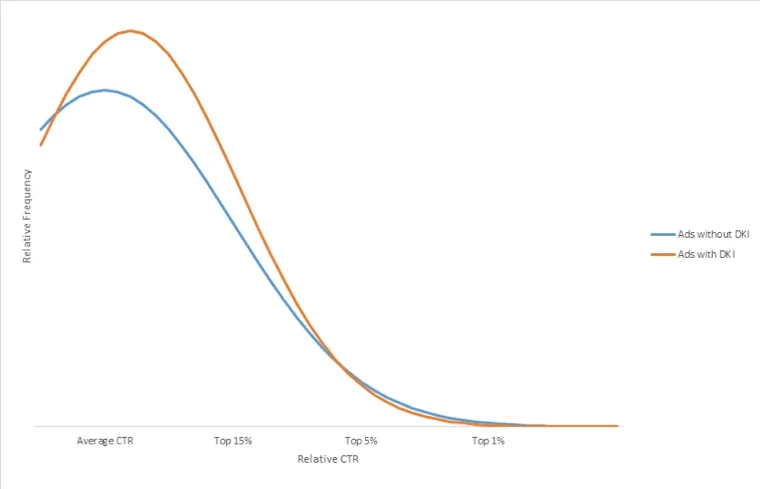
Dynamic keyword insertion is beneficial, but only up to a point, as illustrated below:
Here we have two curves: the red curve corresponds to ads with DKI and the blue to those without. The red curve shows that ads with DKI are relatively more abundant in the top 15%. However, as you move into the top 5% of ads, down to the unicorn ads, you’ll notice that the red curve drops below the blue curve.
Dynamic keyword insertion ads seem to be hitting a wall. This tells us that they should certainly be part of your toolbox, as they tend to produce slightly higher initial returns, but don’t put too much faith in them.
Ad extensions – are they the miracle solution?
Google seems to release new ad extensions almost every week, but what impact does using ad extensions have on ad Quality Score and will it help you become a unicorn?
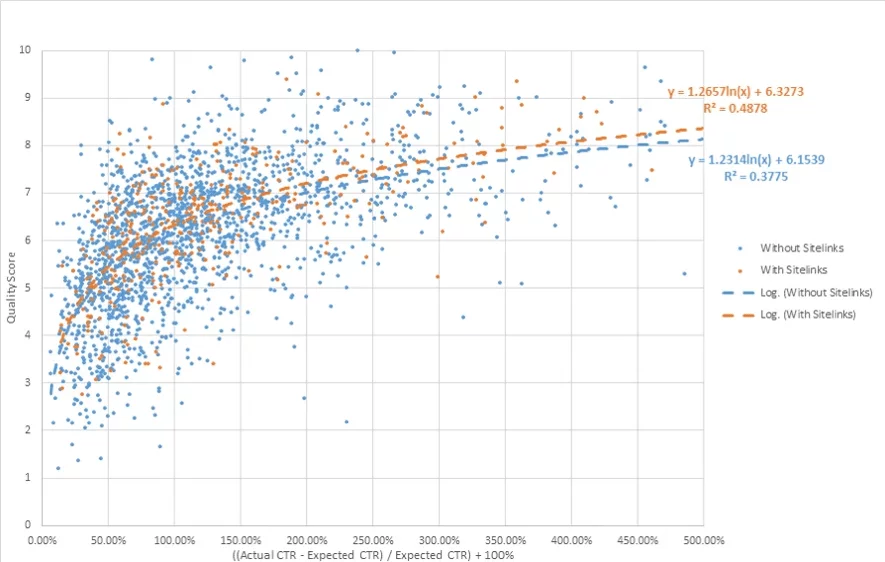
This graph shows that impact, and it’s not a game-changer. We can see that accounts that used sitelinks on their ads did slightly better than those that didn’t, which is no surprise.
Extensions can increase CTR, but they won’t fix boring text. It’s a modest increase, but it won’t double or triple your CTR rates.
Most ads suck. Create emotional ads.
Additional tip: Optimizing mobile ads
Our research has shown that calls from mobile ads convert 3 times more than clicks to a website. When testing mobile ads, you should base your conclusions on call rates, not CTR or conversion rates.
I’ll say it again: focus on call rates and do everything you can to get people to click on the “click to call” button.
What to remember about CTR optimization?
Deleting the bottom third of your account could be a good idea: your low CTR, low impression share and poor performing keywords. The idea here is to maximize the budget you’re currently spending on useless ads.
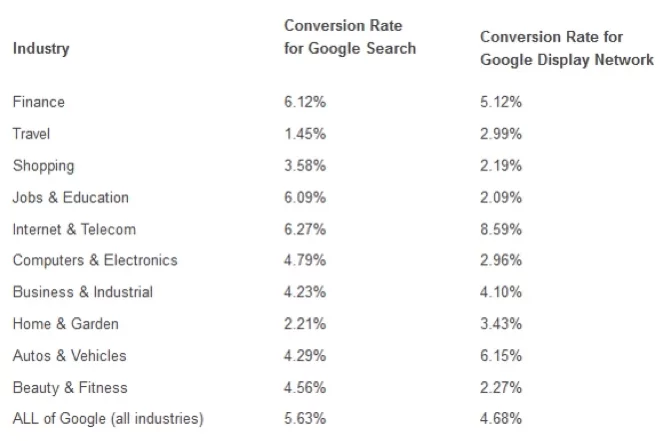
As you can see here, the average cost per click can be significantly lower in a number of areas of the Google Display Network than in Google Search.
Similarly, conversion rates for display ads are comparable to those for search ads, especially when using remarketing. In some sectors, such as automotive and travel, conversion rates for display ads can be even higher.
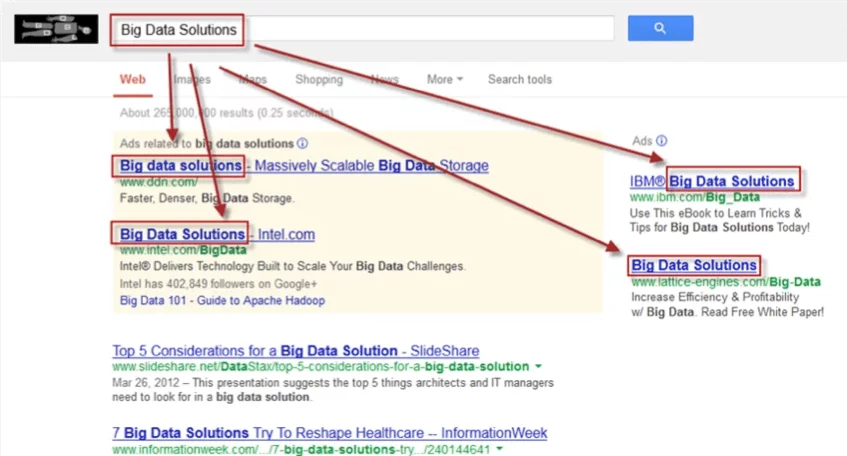
Many search results pages look like this, with boring ads that all look the same. That’s exactly why position can make such a difference, because the only differentiating factor is where an ad appears on the page.
This is a huge opportunity for you.
When you see a bunch of boring, dry, similar ads appearing for a query, you have a chance to stand out and be different. I like to call this the “Google ad jackpot”. The alternative is to find something that stands out from the crowd, that uses emotional triggers.
Create emotionally-charged ads with Swiss army knife brainstorming.
Respected marketer Perry Marshall has devised a structured brainstorming method for creating compelling advertising copy, called the “Swiss Army Knife”. You take different entities such as your customer, something your customer loves, something your customer hates, your customer’s best friend, your customer’s enemy and so on. You then determine how your brand connects or relates to each entity and build from there.
It’s a simple, structured brainstorming process that can help you generate more compelling and emotional ad copy to test, by blending these concepts, like this:
This is a perfect example of a unicorn ad, with a click-through rate of over 30%, that stands out from all the boring divorce lawyer ads.
Your ad copy needs to resonate on an emotional level, and it needs to be different to stand out. You need to test the important elements of your advertising message – things like your guarantee, your unique selling proposition and your offer.
Understanding relative abundance
Unicorns wouldn’t be so special if they were abundant. In fact, only one ad in 100 is a unicorn. The chances of finding it the first time are slim to none; on average, you have to try 100 different ads to find your unicorn.
The more ads you create and test, the more likely you are to come across one that beats the average by 2, 3 or even 6 times!
You don’t test as many ads as you think. You may be thinking, “I already have THOUSANDS of ads on my account! The last thing I want to do is write more ads!”
That may be true, but I can almost guarantee that you’re not testing as many ads as you think. Certainly not all of them were created using the vision and process described above.
Let me tell you a secret: the bar, especially for SMBs, is incredibly low. The average Google Ads account for a small business has just 18 ads. You may not be able to reach 100 ads this month or even this year, but if you work at it and test even 40 or 50, you’re already doing much better than the majority of your competitors.
5% of ads account for 85% of impressions
Here’s more good news: you can get rid of your poorly performing ads, and there are plenty of them.
Across all accounts, we found that the top 5% of ads in an advertiser’s account accounted for 85% of their impressions.
You don’t need to test 100 ads for each ad group in your account.
Instead, choose your top two or three ad groups and concentrate your efforts there. Test them thoroughly, ideally reaching 100 ads to test in each of these top-performing groups.
Of course, you can start by having us audit your Google Ads campaigns. This is an essential first step in determining the health of your Google Ads account and identifying opportunities for optimization. Want to know more? Contact us – Adenlab, your Google Ads Agency
Developing the growth of an e-commerce business often depends on a number of important factors: conversion rate, traffic, average basket, prices…
Attracting a qualified audience, ensuring cross-selling and optimizing pricing and promotions will help you achieve a number of objectives. However, sales don’t happen as a result of a compulsive act or an immediate purchase on your site.
Some customers take time to think before placing an order, especially if the price is high. Indecisive prospects increase the difficulty of converting on your site. What’s more, during this time of reflection, these same consumers will be exposed to other offers for the same or similar products.
How do you make sure they don’t forget you? One strategy: remarketing campaigns via Google Ads and Facebook Ads. If you’re unfamiliar with the concept of remarketing, you’ve probably been confronted with it at least once without knowing it.
The principle is to present an advert to a user who has visited your website or interacted with your social pages (Facebook, Instagram, Linkedin pages).
It may seem intrusive, but this method pays off. How can you set up subtle remarketing campaigns via Google Ads or Facebook Ads without harassing your prospects and customers?
Let’s take a situation you’ve probably experienced. For example, you’ve been looking for a watch or a pair of shoes on a website, and you’ve done some simple scouting on the same site.
In the days that follow, ads for watches and shoes are everywhere: on your Facebook page, Instagram, on your favorite horoscope or weather site …
What a coincidence, you ask? Well, no, it’s not chance, but a remarketing strategy implemented for the site you’ve visited.
In fact, “tracking” the people who have taken actions on your site is commonplace for Ecommerce companies wishing to maximize the ROI of their campaigns, because very often, setting up and distributing retargeting (or remarketing) campaigns is a winning strategy.
Return on investment is almost always guaranteed, because you’re addressing a “pre-qualified” audience whose conversion potential is greater than that of a new visitor.
A subtle example of a remarketing ad: Retarget a visitor who continues to search on Google, with a personalized ad in the Google Search results (Google RLSA campaigns).
Do you find this technique too intrusive? It can be, if it’s not done in the right way. With Facebook Ads and Google Ads campaigns, you can easily retarget your site visitors with different ad formats and ad formats.
What’s more, combining the two platforms will enable you to be more effective in winning over your customers and undecided audiences.
How can Remarketing optimize your conversions?
Invest in “image” and create promotional banners Consistent advertising that reflects the image of your site (color, logo, tone, etc.). Your e-commerce site must be recognizable and attractive.
Test different ad formats! Create several ad formats to see which strategy gets the most clicks and increases your conversion rates. Don’t limit yourself to what’s working: regularly launch new campaigns.
Re-launch your site visitors; as well as anyone who has taken an action on your site (downloaded a freebie, subscribed to the newsletter…).
Apply several targeting strategies with Facebook. You can highlight your content to people who have taken an action on your page (like, comment, share), but also target people who have taken specific actions on your site, e.g. visiting the “Rates” page.
Re-target with a promotional offer, for people who have left their basket without making a purchase.
Reduce your mailing lists to target the most recent prospects, who are most receptive to your offers.
Optimize your product and service landing pages to increase your conversion rates.
Increase your bids and don’t limit the budgets of Remarketing campaigns or ad groups.
Set up remarketing campaigns with Google Shopping.
Usedynamic ad formats to be as close as possible to what your prospects are looking for in Google search results.
Exclude audiences you’re not interested in: it’s sometimes a good idea to exclude web users who have recently purchased and converted on your site. Their keys can be retargeted later via emailing campaigns and become potential buyers and loyal customers.
The aim of these actions is not to be intrusive or to chase after unqualified prospects. The sole aim is to be present at the right time, and for the right amount of time. Your brand needs to present itself as the right solution.
What are the advantages of remarketing strategies?
Although it’s difficult to harness the full power of targeting and remarketing strategies, usually because of limited budgets, the effort is well worth it, as these actions offer many advantages:
Lower acquisition costs
Build customer loyalty and propose new offers
Increase complementary sales
Increase online store visibility
Optimizing return on investment
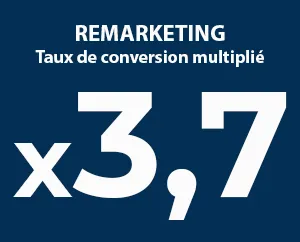
For example, on 2O accounts in similar sectors that we manage on Google Ads, we have seen a 3.7-fold increase in the conversion rate on remarketing audiences!
Targeting qualified audiences and running remarketing campaigns shouldn’t feel like an intrusion into your prospects’ lives. This type of advertising campaign enables every e-commerce site to become unavoidable and to face up to the competition while communicating with interested consumers.
Conclusion
To help you launch your campaigns and apply effective remarketing strategies, our team of Ecommerces experts will be happy to discuss your needs with you. We’ll work with you to optimize the structure of your accounts and campaigns, to segment and parameterize your target audiences and priority profiles.
Reviewing the architecture of your accounts on Google Ads and Facebook will be a priority to manage campaigns by Audience type. Adenlab, our SEA agency, certified Google Partner Premier and Facebook Ads, is at your service.
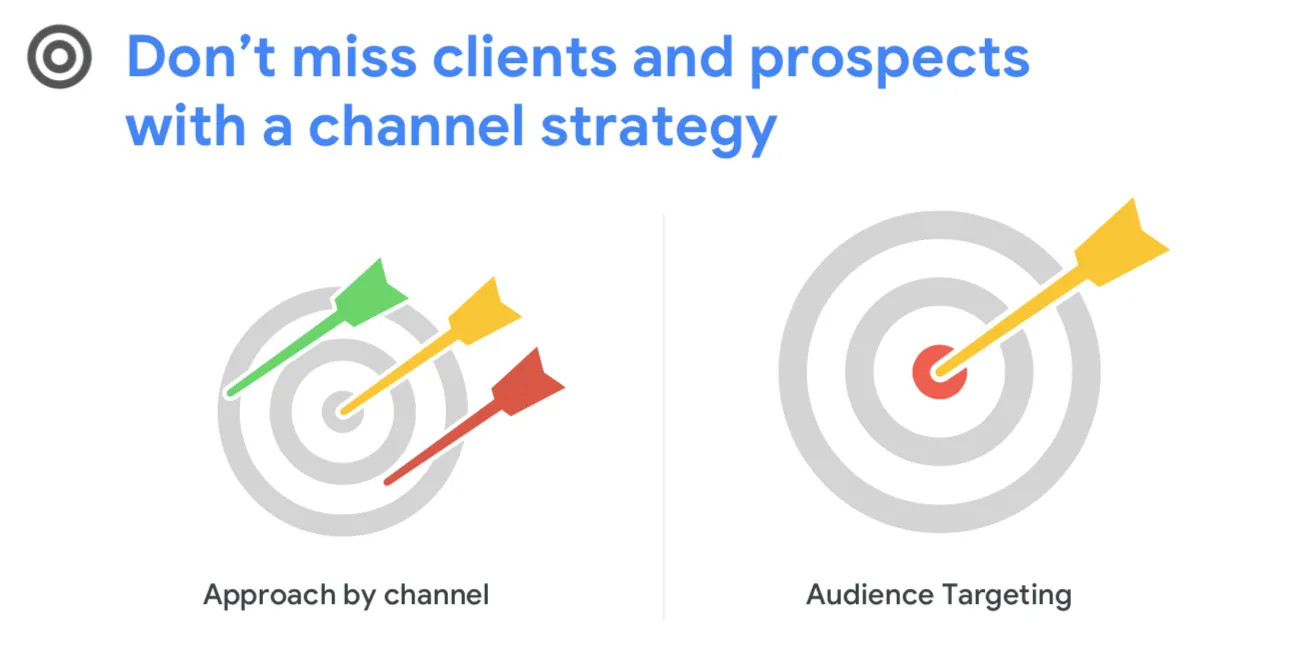
When developing your business and e-commerce, you want to reach the widest possible audience to ensure your company’s growth and profitability. But to convert and build loyalty, you need to be able to address the right people with the right message , and not just the general public.
In the article below, we’ll review the principles of targeting and persona, essential for formulating your strategy for acquiring new customers and prospects. We’ll focus on the different audience optimization levers we can implement on your Google and Facebook campaigns.
Audience targeting levers are extremely important in managing campaigns on search engines, the Display advertising network and social networks.
Unlike physical stores, which have a conversion rate of 55%, e-merchant sites convert between 1% and 3% of visitors. So it’s essential to attract visitors with a clear interest in your products and services.
Persona: the key to understanding your customers
To optimize your approach and ensure successful communication, it’s essential to establish one or more customer profiles. These are known as personas.
This has many advantages:
1 Understand their problems and present the ideal solution
2 Identify your audience to target your Google campaigns and Facebook ads
3 Identify their habits to be present in the right place at the right time
The persona study allows you to put yourself in your audience’s shoes and find the right words.
How do you create a persona?
To identify the real problems and habits of your audience, you need to think deeply. Put yourself in the shoes of your ideal customer.
List their demographic and behavioural data, consumer habits, daily problems… One possible approach is to create a typical day: from dawn to dusk, what does your ideal customer do?
There are several sites that allow you to create personas using just a few pieces of data: SurveyMonkey, UseForge, Up Close and Persona or Personapp.
Example: Here’s my simplified persona
Example: Here’s my simplified persona
The process of setting up a persona is not necessarily a simple one, and can take time (brainstorming, teamwork, etc.).
On the other hand, once you’ve done it or redone it, it opens up new possibilities, new ideas for improving your offers and, of course, your acquisition campaigns.
It’s a very rich exercise that I recommend doing as a team.
Creativity: Address your prospects with an attractive message
Convey the right message on the right medium, and maintain the high quality of your advertising.
Now that you know your customers better and want to guarantee a return on investment from your campaigns, you need to convey the right message on the right medium, and keep the quality of your advertising (image, video, content, text) at a high level.
In fact, targeting and persona work won’t be enough if the quality of the ads and advertising creatives isn’t up to scratch.
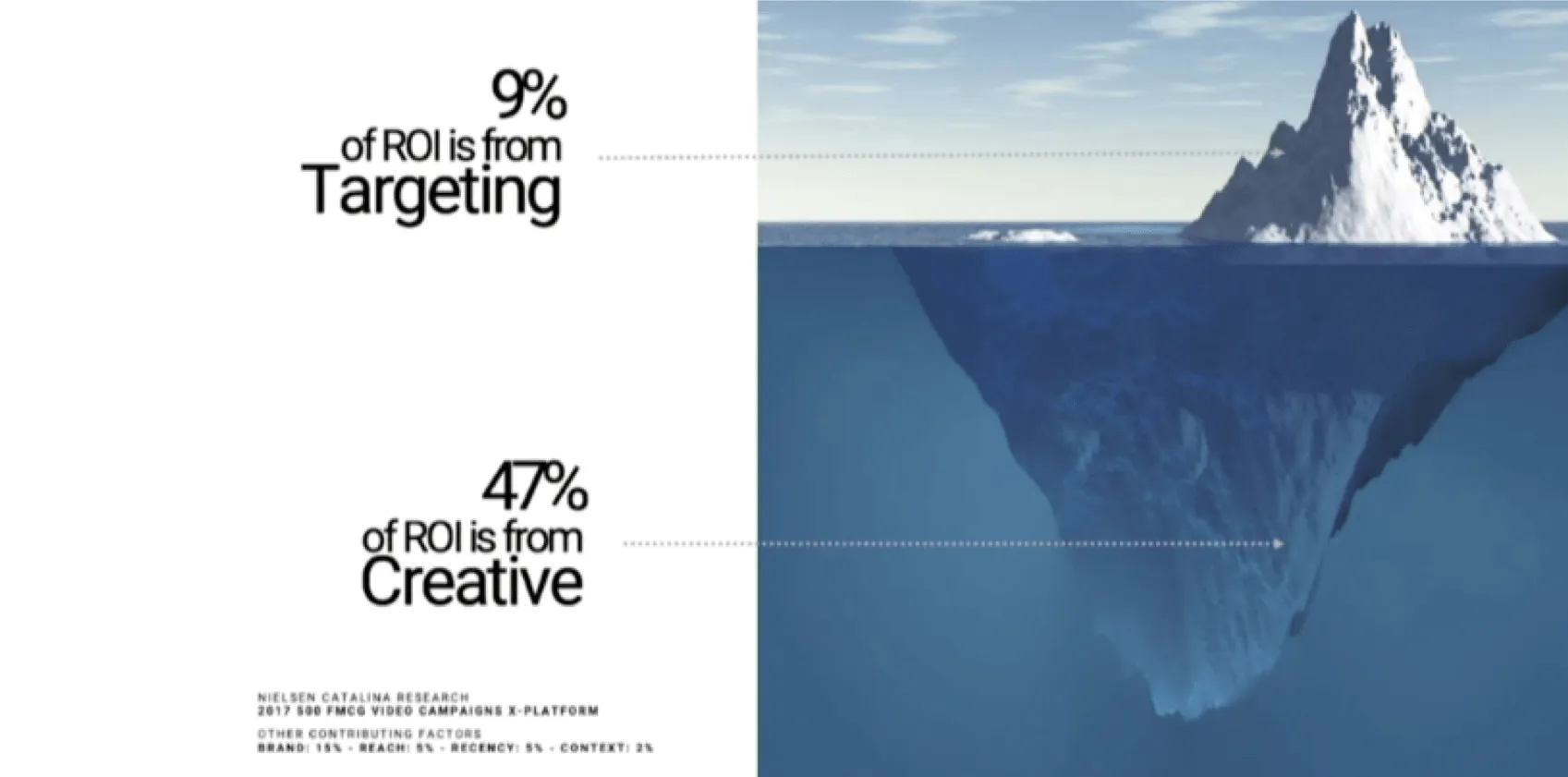
Nielsen Catalina Research study: 47% of ROI is attributed to the quality of advertising creative
Nielsen Catalina Research study
The quality of the images and the message is still a major factor in attracting new customers. What resonance will the ad have after it has been seen? The Nielson study is clear: 47% of ROI is attributed to the quality of the creative.
With the right design, we can ensure optimal distribution on the various channels: search engines, Display, social networks ….
Consumer behavior has evolved in recent years, and has become increasingly complex.
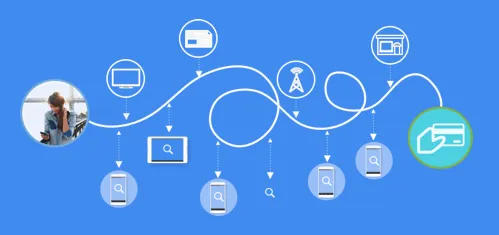
10 years ago, a customer’s path to purchase was still relatively straightforward, but today there are many more interaction points before a purchase or conversion on your site.
You need to be seen in the right place, at the right time, with the right message.
This means delivering your ads across multiple formats and channels, and paying particular attention to performance, budget allocation and sales/conversion attribution analysis.
In fact, the evolution of cell phones and the number of screens per household are multiplying the points of contact with your customers.
“With nearly 5 billion mobile users worldwide, 6 screens per household in France, and more than half of all searches carried out on Google in France and worldwide from a smartphone, the points of contact between consumers and brands have multiplied.” Roland Duffau, Google
To better understand this evolution, Google and Facebook, as well as agencies like Adenlab, have invested heavily in Machine Learning (AI) technologies.
These learning algorithms enable marketers to make the most of the signals of intent left by Internet users as they navigate the web.
How to leverage audiences and retargeting (or remarketing) with Google Ads campaigns?
The different types of audiences offered by Google enable you to reach individuals along their decision-making paths.
Whether for traffic prediction, virtual assistants, fraud detection… Machine Learning is at the heart of Google Ads or Facebook Ads tools.
The use of Machine Learning algorithms today makes it possible to simplify complex tasks and focus on business objectives, define qualified audiences, and then let the algorithms determine who to engage as relevant prospects.
Below, we’ll illustrate the different types of audiences offered by Google, which enable us to reach individuals along their decision-making paths.
Use an audience-based approach in your Google Ads accounts
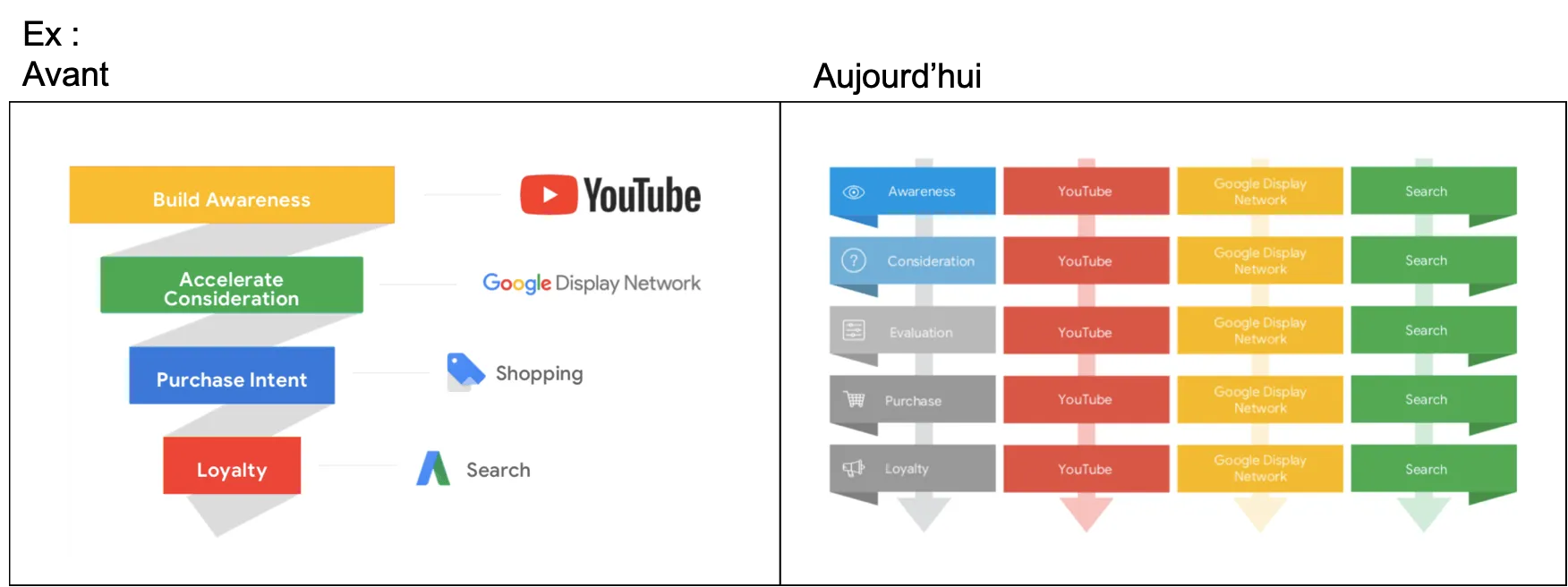
In recent years, one of the major challenges for Google Ads has been to break down the silos between ad formats and audiences:
In the past, when we wanted to target an audience with high purchase intent, we preferred the Google Shopping format (and sometimes the text format).
Today, with the right Audience settings, when we target “buyers”, we use Google Shopping, Text Ads, but above all what’s changing is that we also use the Display Network and YouTube!
In terms of targeting, Google Ads technology has clearly evolved, making it possible to use many more formats and distribution channels to achieve your growth and ROI objectives.
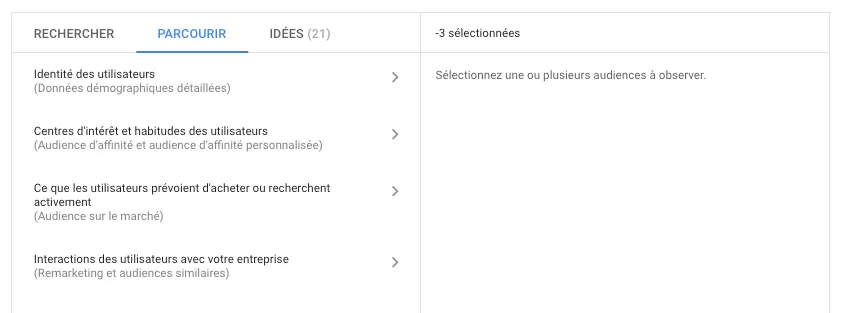
What are the main types of Audiences and how can they be used in your targeting strategy?
We leave “traces” everywhere on the web (and anonymously). Every day, we emit signals that are stored (thanks to cookies), analyzed and interpreted; This makes it possible to understand and categorize behavior and people into different audiences.
These audience categories can be used to manage campaigns on Google Ads or Facebook Ads. They enable us to target and prioritize a certain type of person according to our campaign objectives.
Ex: If our goal is to gain more visibility for my brand, I’ll target a demographic audience and an affinity audience.
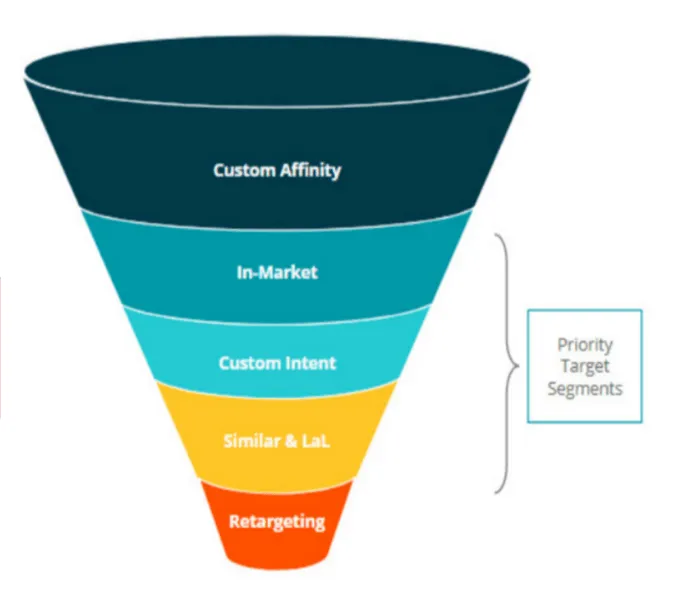
Illustration of audience typologies in relation to your conversion funnel
Audience demographics
Generally used to target (or exclude) a large audience, they can be used to promote your company by segmenting users according to age, gender, income, profession or family composition (married or not, children…).
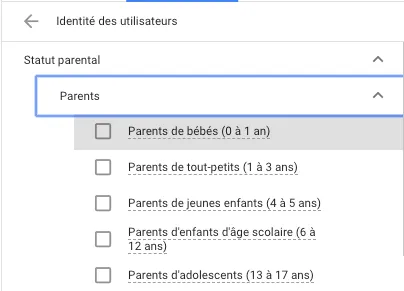
Example in Google Ads of a demographic audience selection: here Parental status
Here’s an example in Google Ads of demographic audience selection, by parental status.
Affinity Audiences and Personalized Affinity Audiences
These audiences will enable us to target an audience that is close to your buyers and has been identified as having a real interest in your products and services; in fact, it’s their lifestyle, habits and interests that are analyzed.
Custom affinity audiences will allow you to combine additional parameters in Google Ads, such as keywords to target, Urls and site content, the types of places your prospects frequent, and the applications they’re likely to use.
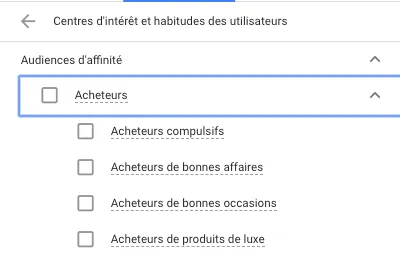
Example of audience selection by buying behavior
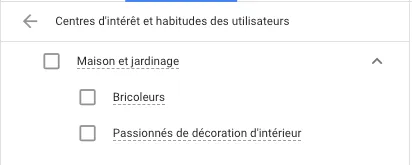
Example of a center of interest
Life event
These audiences allow us to target people who are going through occasional events in their lives, such as weddings, births, but also moves…
Its audiences have multiple needs. If we take the example of a birth, I can assure you that Google searches for “strollers”, “cribs”, “do I make a good father” will be regular searches. Definitely worth implementing!
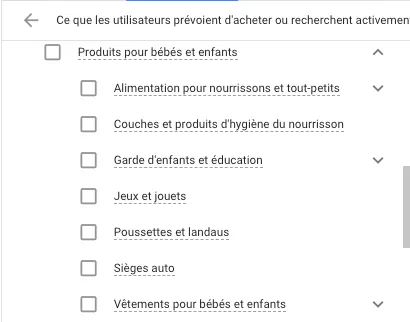
Market audiences
With market audiences, you target people who are actively looking for your products and seriously considering buying them.
This is an audience you must activate in your campaigns, as it’s generally more ROI-intensive and even closer to the profile of your current customers and buyers.
Similar audiences
As the name suggests, similar audiences target people whose behavior is very similar to that of your existing customers;
These audience lists are updated in real time! And your ads will be shown to people who have something in common with your ideal customers and prospects.
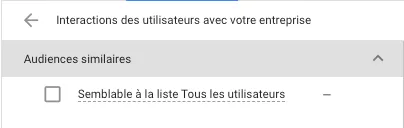
Selection of audiences similar/similar to your regular site traffic
Retargeting (or remarketing) audiences
Re-targeting “known” audiences who have come to your site is often a winning strategy, and doesn’t require too much budgetary effort.
In fact, the people who have come to your site already have a relatively strong intention to buy, and above all, they know you.
However, not every visitor to your site has the same value: you need to segment and distinguish between visitors who have left without doing anything, and those who have abandoned their purchasing process and are therefore much more likely to convert on your site.
Audience Customer Match
To target and exclude this audience, you first need to import your e-mail database into Google Ads.
This audience will also be very useful for creating similar audiences.
Conclusion
These audience typologies are much the same for Facebook ads. As a result, a wide range of approaches can be devised to develop your sales:
Target by interests
Your competitor’s fans or your fans’ friends
Age groups, professions, Facebook activities, geographical locations…
Family status (children, couple, married): useful for advertising events such as Mother’s Day, Father’s Day or Valentine’s Day.
However, before taking the plunge, we recommend an observation phase on Google Ads and Google Analytics.
Over a relatively short period of time (depending on the traffic of your campaigns) you can identify the audiences that best meet your objectives. This observation phase will enable you to refine your segmentations and subsequently optimize your visibility and budget allocation.
Don’t hesitate to consult us for your acquisition strategies and the implementation of audience strategies on Google and Facebook. Our SEA Agency, certified Google Partner Premier and Facebook Ads, applies different methods and uses various automation tools to develop the accounts of E-Commerce customers.
We specialize in high-volume projects and work on catalogs with a large number of references.
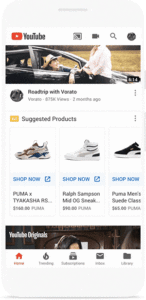
Google launched its Shopping ads on YouTube a few years ago. And just a few weeks ago the Shopping ads were extended:
1. In the Youtube news feed 2. To YouTube search results
This is becoming increasingly interesting for ecommerce advertisers, who will have more options and more space to promote their products via a Shopping feed!
Youtube and videos: sales vectors!
Why is YouTube, in particular, so important for Ecommerces? Well, according to Google**, “nearly two-thirds of shoppers say online video gave them ideas and inspiration for their purchase”, and of those, “90% say they discovered new products and brands via YouTube”.
ROI strategies for e-commerce are essential, and controlling the cost of acquiring a new customer is often the key to success. This is why “Product” formats and the use of shopping feeds for acquisition campaigns are often the most suitable.
With its new options, Google offers merchants an additional lever. Coupled with an appropriate audience strategy, and a bidding strategy consistent with the merchant’s objectives, the format is worth testing!
It’s an option for reaching consumers when and where they’re most likely to “webvitrine”;).
Please note that this is not Retargeting, as the display of Shopping ads depends on the user’s searches and interests. In the example above, a user doing video searches on this or that shoe or on running could be exposed to ads. And it’s the Puma brand whose ads are displayed
What other advertising formats on Youtube are suitable for Ecommerces?
Bumper YouTube Ads
Bumper Ads are short, unstoppable ads lasting up to six seconds. They appear before, during or after the video selected by the user. These ads appear on YouTube videos or on Google’s partner sites and applications. Bumper Ads are an interesting lever for boosting brand awareness and increasing visibility among qualified audiences. It’s a good idea to use them in conjunction with Trueview and other Google campaigns.
Youtube campaign: Trueview
As the name suggests (“True” – “View” => VraieVue), these are videos that are (really;) viewed in their entirety (or almost: more than 30 seconds of viewing). Today, this format seems to be the least “risky” for Youtube, since you only pay when videos are viewed for more than 30 seconds, or if the viewer clicks on the ad. What’s more, you’re not charged for unintentional views.
This format can be found with: Instream ads => shown before, during or after videos on YouTube Video Discovery ads => shown on pages where users discover content, such as the YouTube search results page.
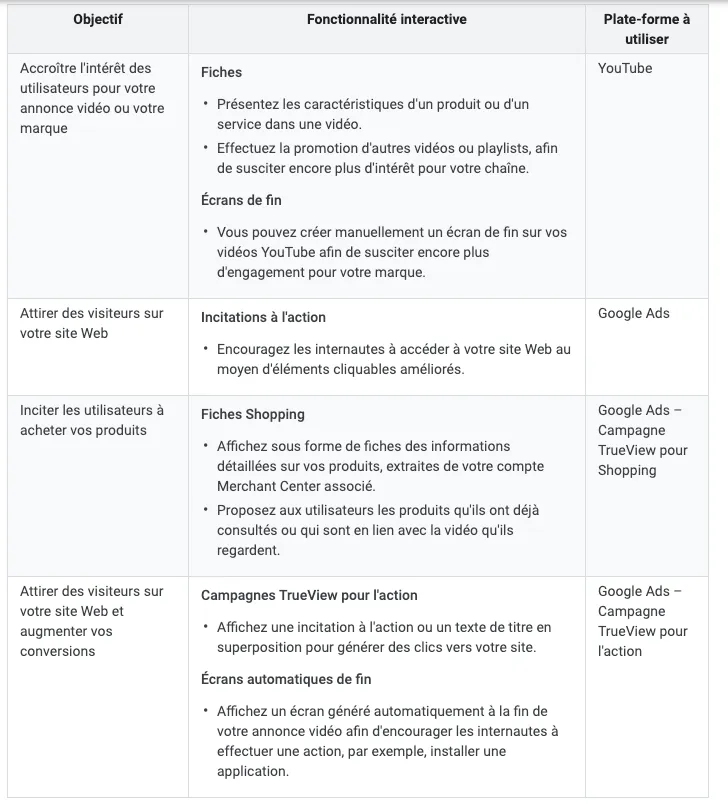
Google offers a number of interactive features to make the most of the Trueview format, depending on your objectives: (more details about interactive video ads on the official Google page)
Trueview for Shopping
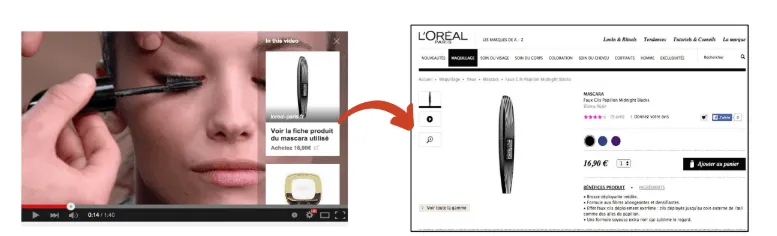
You can also showcase products from your product feed alongside TrueView ads on YouTube. It’s a great way to use video content to enhance your YouTube marketing strategy and increase sales.
These purchase ads enable YouTube advertisers to offer products directly in partner videos.
How do True View ads for shopping work?
It’s easy to set up: just connect your Google Ads account to the merchant center and choose the products you want to relay to the video.
This format is particularly effective for cosmetics brands, but also for other ecommerce players.
Objective Maximize the profitability of media campaigns by promoting engagement with products and services
The Plus
there’s no need to create individual ads for each product.
click on the product to be redirected directly to the product sheet
a pleasant user experience that translates into a higher interaction rate
Conclusion
If you’re not sure that your potential customers might be on Youtube, here are a few statistics that will encourage you to work on this increasingly important platform for advertisers and e-tailers:
Figures for YouTube in France:June 2019 (June 2019, source Youtube Festival, newsletter): 46 million users per month in France.
3rd most visited site according to Alexa, youtube.com accounts for between 3% and 4% of global page views
More than half of all views are on mobile devices
Thanks to YouTube, 8 out of 10 French people know everything there is to know about the sport they love.
75% of French people say they use YouTube to learn about subjects that interest them.
37.5 million French people visit YouTube every month, representing 81% of the connected population.
In France, 66% of Bumper campaigns measured generated a 14% increase in brand awareness.
Contact us
Of course, our team is always ready to discuss possible strategies for your site and e-commmerce. Our SEA Agency is here to help you! Don’t hesitate to give us a call at +33183819060 or send us an e-mail at contact@adenab.com.